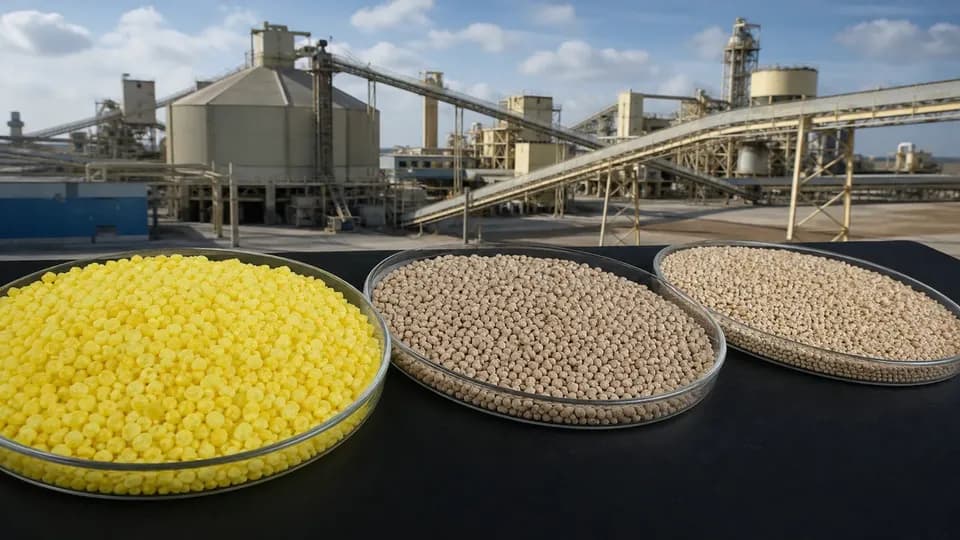
Why Sulphur Is Becoming a Strategic Commodity for Industrial Buyers
نُشر في 9 أكتوبر 2026
A buyer-focused sulphur market outlook covering fertilizer demand, critical-mineral processing, by-product supply, logistics risk and practical procurement steps.
Sulphur rarely receives the attention given to lithium, copper or nickel. Yet a serious sulphur market outlook now has to look beyond one yellow bulk commodity. Sulphur is the principal feedstock for much of the world’s sulphuric acid, and that acid sits behind phosphate fertilizer production, mineral processing and a wide range of industrial operations.
That does not mean sulphur is formally designated a critical mineral in every jurisdiction. The more useful conclusion for buyers is operational: an interruption in sulphur or sulphuric acid can slow several strategic value chains at once. In 2026, the International Energy Agency highlighted this connection directly, describing sulphur as essential to fertilizer production and to the processing of copper, lithium, cobalt, nickel and rare earths.
For procurement teams, the question is therefore no longer only, “What is today’s sulphur price?” It is also, “How resilient is our supply route, specification, contract and delivery plan?”
Why the sulphur market outlook matters
The global sulphur market is shaped by an unusual combination of demand growth and supply dependence. Fertilizer remains the structural anchor, while mining and battery-material processing add pressure in selected regions. On the supply side, most elemental sulphur is recovered as a by-product when oil and natural gas are processed, rather than produced because a sulphur buyer placed an order.
This difference matters. A mine can sometimes respond to a higher commodity price by expanding the output of its main product. Recovered sulphur supply is more closely linked to refinery throughput, gas-processing volumes, feedstock sulphur content, environmental controls and the economics of the host operation. Sulphur prices can rise without creating an immediate equivalent supply response.
The market’s strategic importance became visible during the 2026 disruption in the Middle East. The IEA reported that the region supplies roughly one-quarter of global sulphur and that about half of global seaborne sulphur trade normally passes through the Strait of Hormuz. Conditions can change quickly, but the procurement lesson is durable: origin diversity and route resilience matter.
Sulphur is recovered more often than it is mined
The U.S. Geological Survey describes elemental sulphur production as recovery from petroleum refineries, natural-gas-processing plants and, to a smaller extent, coking operations. A peer-reviewed 2026 study in Green Chemistry estimates that about 80% of the elemental sulphur used by industry originates from fossil-fuel desulphurization.
This by-product model has historically delivered abundant material. Geological resources are not the immediate problem: USGS notes that sulphur resources associated with hydrocarbons, sulphide ores, evaporites and other sources are very large. The commercial risk is availability at the required time, in the required form, at a workable location and delivered cost.
That distinction prevents two common mistakes. Buyers should not confuse large geological resources with guaranteed prompt cargo availability, and they should not treat long-range shortage scenarios as certain forecasts. The pace of decarbonisation, refinery and gas output, new acid capacity, smelter production, recycling and alternative technologies will influence the actual balance.

Fertilizer keeps sulphur tied to food supply chains
Sulphuric acid is fundamental to the production of phosphoric acid from phosphate rock. The International Fertilizer Association identifies phosphate fertilizer production as the primary industrial market for sulphuric acid and the largest industrial use of sulphur. This is why sulphur availability can move through the value chain into DAP, MAP and other phosphate fertilizers.
For fertilizer producers, sulphur procurement is not simply a spot-purchase exercise. Acid-plant operating rates, phosphate-rock availability, seasonal fertilizer demand, plant maintenance and port or inland logistics can change the value of a cargo. A low headline price can be misleading if the delivery window, physical form or quality does not match the receiving operation.
Critical-mineral processing adds another demand channel
Sulphuric acid is widely used in leaching and hydrometallurgical processing. It supports parts of the copper, nickel, cobalt, lithium and rare-earth supply chains. High-pressure acid leaching, for example, can require substantial acid infrastructure when processing lateritic nickel ores.
The Green Chemistry study published in 2026 found sulphuric acid to be the most heavily used reagent across the battery supply chain it assessed. Its scenario analysis indicates that battery-cell manufacturing and its upstream materials chain could require an amount equal to 14–26% of current sulphuric acid production by 2040. This is not a single-point market forecast, but it illustrates why chemical reagents deserve a place in critical-mineral procurement planning.
The strategic issue is indirect but powerful. Energy-transition technologies increase demand for minerals, while the conversion of some ores into usable products depends on acid made from a commodity still closely tied to oil and gas processing.
Why Middle East supply and shipping lanes matter
The Middle East combines large oil and gas operations, sulphur recovery, export terminals and proximity to important fertilizer and mineral-processing markets. It also means that port performance, storage, vessel availability, sanctions and compliance checks, export policy, insurance and maritime chokepoints can quickly influence delivered cost and timing.
Buyers evaluating Middle Eastern or nearby supply should compare more than FOB numbers. The useful comparison is landed cost and execution risk: product form, confirmed specification, loading point, shipment size, laycan, freight, discharge capability, inspection, documentation and the legal ability of all parties to perform the transaction.

What sulphur buyers should monitor
Monitor refinery and natural-gas-processing rates in major producing regions; phosphate fertilizer operating rates and import tenders; sulphuric acid plant and non-ferrous smelter maintenance; producer posted prices and spot indications; port stocks, freight and terminal congestion; export restrictions, sanctions and banking constraints; and the availability of the required product form.
Physical indicators matter more than headlines alone. A market can look well supplied globally while a particular region, product form or logistics corridor is tight.
How procurement teams can reduce exposure
Define the requirement before requesting a price. State the product form, purity basis, moisture, ash, acidity, particle-size or fines requirements, quantity, destination, delivery window and intended application.
Separate reference specifications from binding cargo acceptance criteria. The quotation, contract, inspection procedure and certificate requirements should describe the same product. Compare landed scenarios, qualify the counterparty and cargo, and confirm the seller’s authority, origin, inspection access, document set, payment route and compliance position before committing funds.
Where appropriate, a blend of term volume, optional volume and spot coverage can reduce dependence on one loading window. The right structure depends on consumption, storage capacity, financing and operational risk.

From market outlook to procurement decision
The strongest conclusion from current sulphur market trends is not that every buyer should stockpile or that a global shortage is inevitable. It is that sulphur deserves the disciplined planning applied to other process-critical raw materials.
A robust procurement plan connects market intelligence to a cargo that can actually be received and used. Buyers should match the commercial offer to plant requirements, verify the cargo and counterparty, and understand where the supply route is most vulnerable. Price remains important, but reliability, specification and logistics increasingly determine the true cost of supply.
For current product information and commercial parameters, review the granular sulphur product page.
Qualified buyers can submit the required specification, quantity, destination and delivery window through the MatinTouch RFQ form.
Frequently asked questions
Is sulphur a critical mineral?
Sulphur is not universally listed as a critical mineral. Its strategic importance comes from its role in sulphuric acid and the dependence of fertilizer, mining and chemical processes on that acid. Buyers should treat it as process-critical where interruption would stop or materially reduce production.
Is the world running out of sulphur?
Large sulphur resources exist. The more immediate risks concern commercially available supply, regional concentration, production as a by-product, logistics and the timing of demand. Long-range shortage estimates are scenarios, not guaranteed outcomes.
What drives sulphur prices?
Key drivers include oil-refinery and gas-processing output, phosphate fertilizer demand, smelter and acid-plant operations, producer pricing, inventory, trade policy, freight and disruption at ports or transport corridors.
What should a bulk sulphur RFQ include?
Include the required form and specification, quantity, destination, Incoterm, shipment window, packing or bulk requirement, inspection and sampling method, document set, payment constraints and any destination-specific compliance requirement.
Sources and methodology
International Energy Agency — Global Critical Minerals Outlook 2026.
U.S. Geological Survey — Mineral Commodity Summaries 2026.
International Fertilizer Association — Phosphate Fertilizer Production Factsheet.
Royal Society of Chemistry — Chemical Reagents in the Electric-Vehicle Battery Supply Chain.
Information current as of October 2026. This article provides general market and procurement information, not a binding offer, price forecast, legal opinion or compliance advice. Availability, specifications, prices and shipment terms must be confirmed for each transaction.