Granular Sulphur Specifications: A Buyer’s Contract Checklist
Published September 11, 2026
A practical granular sulphur specification guide covering dry-basis purity, moisture, reference ranges, trace components and the terms buyers should confirm before contracting.
A granular sulphur specification should separate confirmed product information from cargo-specific acceptance terms. This checklist helps industrial buyers frame an RFQ, compare offers and make the final contract scope clear.
Approved product specification
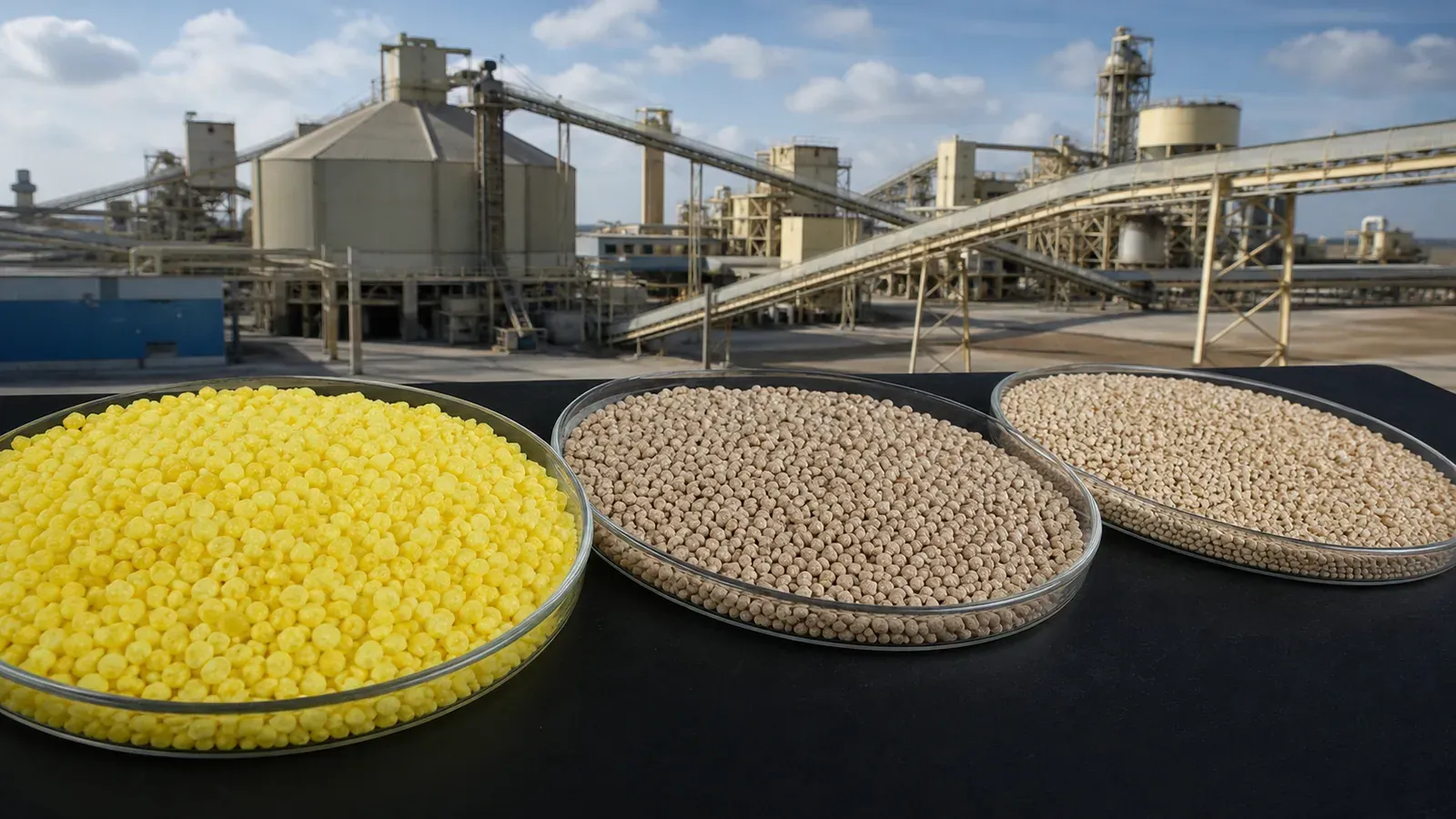
The product is granular sulphur, yellow in colour. Approved product information states purity of 99.5 wt% minimum, dry basis, and moisture below 0.3 wt%.
Ash is shown as a reference range of 0.02–0.2 wt%. Acidity, expressed as H₂SO₄, is shown as a reference range of 0.001–0.05 wt%. These are reference ranges, not guaranteed maximum limits; acceptance limits should be confirmed in the quotation or contract.

A quick reference to the approved granular sulphur product information. Final shipment acceptance remains subject to the agreed commercial terms.
Why “dry basis” belongs in the contract
Purity and moisture describe different aspects of the material. Keeping “99.5 wt% minimum, dry basis” in the agreed specification prevents the purity basis from being interpreted differently when offers or documents are compared.
How to handle trace components
Arsenic, selenium, tellurium and chloride are identified as Trace. Trace is not a declaration of zero, absence or a numeric limit. If a buyer needs a numerical limit or a particular analytical method, that requirement should be agreed before contracting.
Specifications not published for this product
No density, particle-size distribution or fines value is published for this product. Buyers with handling, processing or application requirements should state the relevant physical acceptance criteria in their RFQ rather than assume an unconfirmed value.
Practical RFQ checklist
State the required form, purity basis, moisture limit, destination, quantity, loading window, packing or bulk-shipping requirements, inspection method and document set. Where ash or acidity matters to the process, define the acceptance limit and method in the commercial terms.
How to compare supplier offers
Compare like with like before choosing an offer. Check whether purity is stated on the same basis, whether the moisture wording is a limit or a typical value, and whether any ash or acidity language is a reference range or a contract acceptance limit. Price alone does not make two specifications equivalent.
Ask each supplier to identify which terms are product information, which are shipment-specific commitments and which will be shown in the agreed document set. This makes it easier to identify a meaningful variance before nomination, loading or payment.
Aligning the specification with the receiving operation
The receiving plant should define the characteristics that materially affect its process, storage, safety or downstream use. If a parameter outside the approved product information is essential, include a clear limit, unit, test method and sampling basis in the RFQ and sales contract.
The same discipline applies to logistics. Bulk or packed delivery, delivery point, inspection location and the point at which risk and acceptance transfer should be consistent across the quotation, contract and shipping instructions.
Sulphur HS code and document checks
HS classification is a customs matter and should be confirmed for the importing jurisdiction, the product form and the actual declaration. Buyers should align the HS code, origin documents, safety documentation and any destination-specific requirements before shipment.
Product information is not a cargo CoA
This product information is not a certificate of analysis for a particular shipment and does not represent a laboratory result for a cargo. Shipment documentation, sampling and acceptance procedures should be agreed separately.
Before loading and after arrival
Before loading, confirm the agreed specification, quantity tolerance, inspection appointment, document requirements and notification sequence. On arrival, follow the contract’s sampling, inspection and claims procedure. A clear procedure protects both buyer and seller when a commercial question arises.
Next step for industrial buyers
For the current product overview, see the granular sulphur product page. For a firm offer, confirm the full commercial specification, logistics and document requirements with the supplier.
Information current as of September 2026. It is provided for general product guidance; final acceptance criteria remain subject to quotation and contract.