
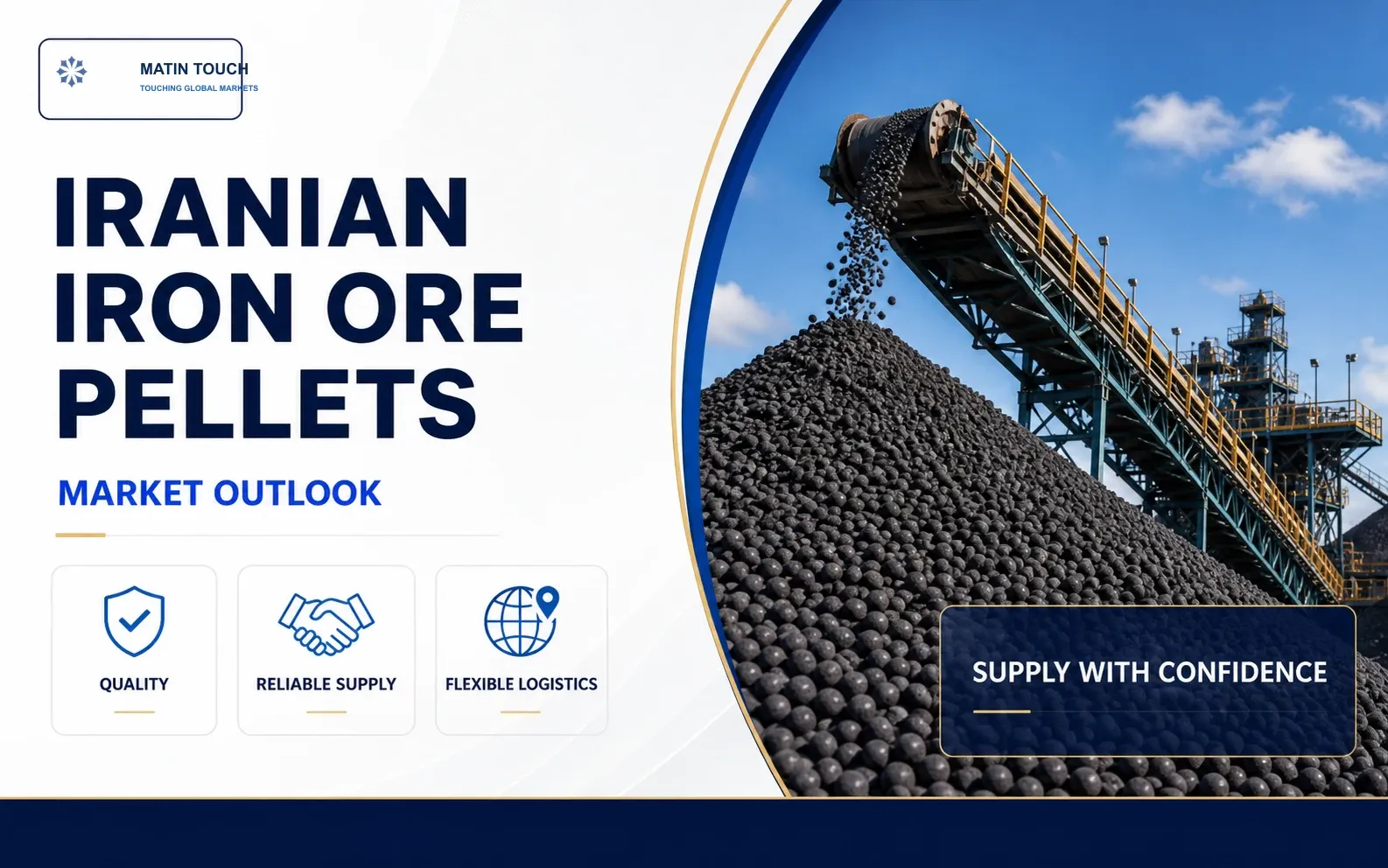
Iranian Iron Ore Pellets: Market Outlook, Quality and Export Considerations
Published August 29, 2026
A practical guide for industrial buyers assessing Iranian iron ore pellets, from specifications and inspection to logistics and commercial execution.
Iron ore pellets are more than a bulk commodity. For a steelmaker, their value depends on the delivered iron unit, chemical and physical consistency, metallurgical fit and the reliability of the supply chain behind the cargo.
For qualified buyers considering Iranian supply, the useful question is not simply whether pellets are available. It is whether the proposed product, documentation, inspection plan and logistics match the receiving plant and the intended steelmaking route.
Why pellet quality matters
Pellets are engineered agglomerates made from fine iron ore concentrate. Uniform sizing and controlled chemistry can support more predictable handling and furnace performance than an undifferentiated ore offer. The exact value depends on the buyer’s process, whether blast furnace, direct reduction or another route.
A professional review should cover iron content, silica, alumina, phosphorus, sulfur, moisture, size distribution, cold crushing strength and any specification needed by the receiving plant. A headline Fe percentage alone is not enough to compare two cargoes responsibly.

Pellet quality should be verified against the agreed specification and inspection plan.
A changing steel and iron ore market
The World Steel Association’s April 2026 short-range outlook projected modest global steel-demand growth for 2026, followed by a stronger increase in 2027. Read the outlook.
In this environment, suppliers compete on more than headline price. Buyers evaluate product suitability, consistency, loading reliability and full delivered cost. The OECD’s 2026 steel outlook similarly highlights a market where capacity, trade flows and demand conditions need to be assessed together rather than through one benchmark alone.
For broader market context, see the OECD Steel Outlook 2026.
Iranian pellets: the buyer proposition
Iran has an established iron and steel value chain that includes mining, concentrate production, pelletizing and direct-reduction steelmaking. This makes Iranian pellets a relevant option for buyers seeking processed iron units rather than only raw ore.
Every supply opportunity remains transaction-specific. Product availability, export permissions, loading point, vessel or rail availability, payment structure and destination requirements must be confirmed for the proposed shipment. General market information should never be treated as a firm offer.
A practical buyer checklist
1. Product specification: agree the chemical and physical specification, test method, tolerances and rejection procedure before contracting.
2. Metallurgical fit: confirm whether the pellet grade is suitable for the receiving process, including any direct-reduction requirements.
3. Independent inspection: define sampling, analysis, quantity determination and the inspection company acceptable to both parties.
4. Documentation and traceability: review the certificate of analysis, origin and export documents, production or warehouse information and the chain of title to the cargo.
Logistics and commercial execution
The route should be assessed as a complete delivered-cost calculation, not as a distance on a map. Loading location, port or rail terminal capacity, shipment size, transshipment, customs process, insurance, Incoterms and final plant access all affect the commercial result.
For China, Central Asia and other Asian destinations, buyers should compare feasible maritime, rail and multimodal options for the specific origin and delivery point. The commercially sound route is the one that can be documented, scheduled and executed under the agreed terms.

Supply planning should connect verified product, inspection, logistics and delivery terms.
How Matin Touch supports qualified inquiries
Matin Touch helps qualified industrial buyers assess available Iranian mineral offers, compare specifications, review supporting documentation, coordinate inspection requirements and evaluate practical delivery options. Availability, price and commercial terms are confirmed separately for each transaction after counterparty and compliance checks.
To begin an assessment, send the required specification, quantity, delivery point, shipment window and inspection requirements through the Matin Touch RFQ form.
Sources and methodology
Market context: World Steel Association short-range outlook, April 2026.
Industry context: OECD Steel Outlook 2026.
Mineral commodity reference: USGS Mineral Commodity Summaries 2026.
This article is general market information, prepared from public sources available in August 2026. It is not a firm offer, investment advice, legal advice or a substitute for transaction-specific technical, compliance and logistics due diligence.